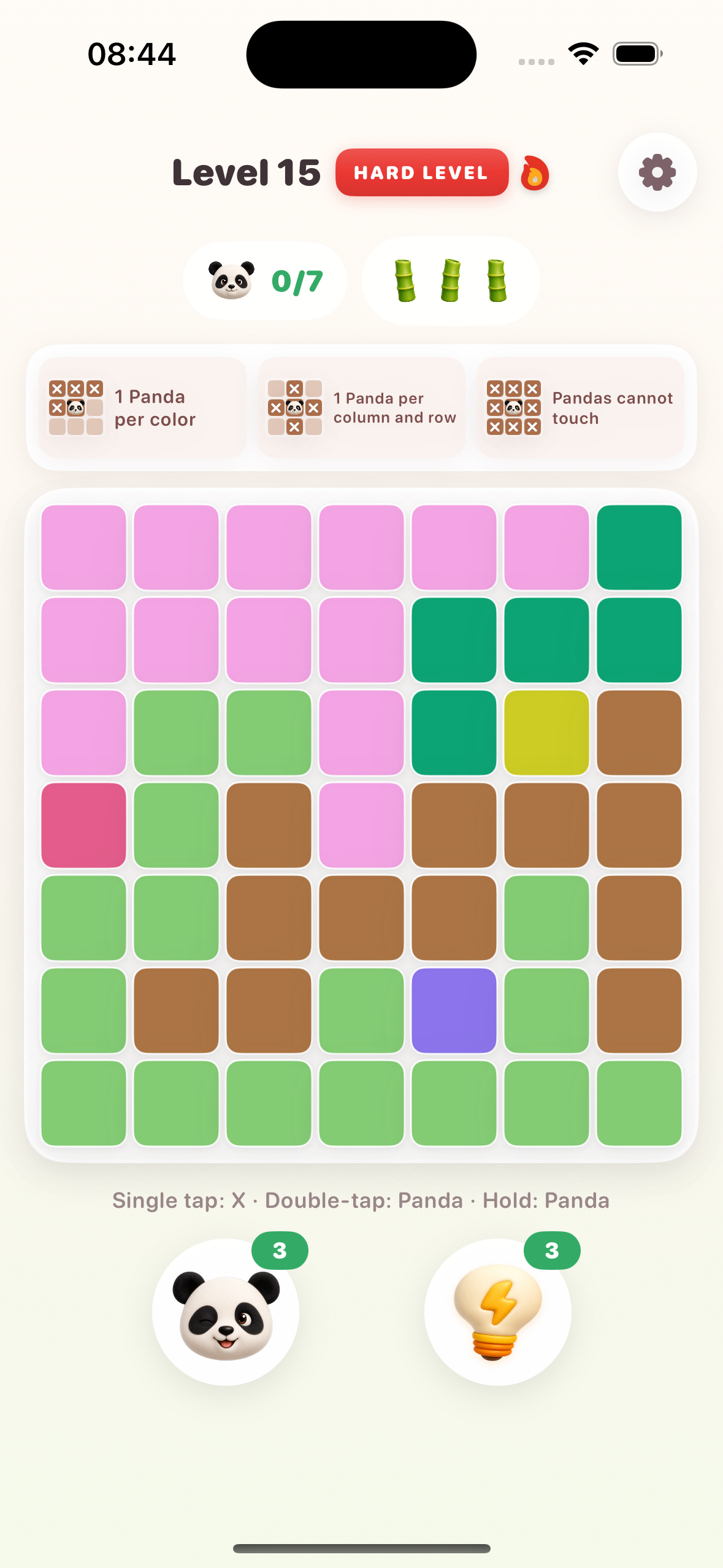
Pandaku is a placement logic puzzle, not a number puzzle. The board is split into colored regions, and your job is to prove the one square in each region that can hold a panda. A correct solution has one panda in every horizontal row, one in every vertical column, one in every color, and no two pandas touching in any direction.
Single-tap an empty square to mark it with an X. Double-tap or hold when the logic proves a panda belongs there. X marks are notes rather than guesses: they record squares that a row, column, region, or nearby panda has already ruled out.
What are the four Pandaku rules?
The first three rules each demand exactly one panda: one per row, one per column, and one per colored region. The final rule says pandas cannot touch, including diagonally. A square is legal only when it satisfies all four constraints at once.
Rows and columns provide long straight exclusions. Colored regions can bend around the board, so their shape often creates the most interesting deductions. The no-touch rule works locally: once a panda is placed, the eight neighboring squares are impossible.
- Every row ends with exactly one panda.
- Every column ends with exactly one panda.
- Every colored region ends with exactly one panda.
- Pandas cannot be neighbors horizontally, vertically, or diagonally.

How do X marks work?
An X means “a panda cannot go here.” Marking exclusions keeps the board readable and turns a large region into a smaller set of candidates. When only one unmarked square remains in a row, column, or color, that square becomes a forced panda.
Pandaku is tuned for touch: tap a square once to toggle an X, or drag across several empty squares to paint exclusions quickly. Begin a drag on an existing X to erase marks instead. A correctly placed panda stays protected while you sweep through its row or column.
Where should a beginner start?
Start with the smallest or narrowest colored region. Ask which rows and columns its squares occupy, then remove any square blocked by a known panda or the no-touch rule. Next, scan rows or columns that already have many X marks. The best opening move is usually where multiple constraints overlap.
Avoid placing a panda simply because a square looks likely. Every generated Pandaku board is validated to have a deterministic solution, so a real deduction is always available. If you feel stuck, rescan colors before spending a hint.
A practical solving loop
- 1
Scan the tightest colored region and count its remaining candidate squares.
- 2
Mark squares excluded by completed rows, columns, regions, or neighboring pandas.
- 3
Place a panda only when one candidate remains or several constraints prove the same square.
- 4
Repeat the new exclusions created by that panda until the whole board is solved.