The no-touch rule is more than a restriction: it is one of the strongest sources of information on the board. A panda immediately creates a ring of impossible squares, and those X marks can collapse a nearby color region to its only legal cell.
Rows and columns already prevent horizontal or vertical neighbors, so the surprising part is usually the diagonals. Two pandas cannot sit corner-to-corner, even when they belong to different colors and different rows and columns.
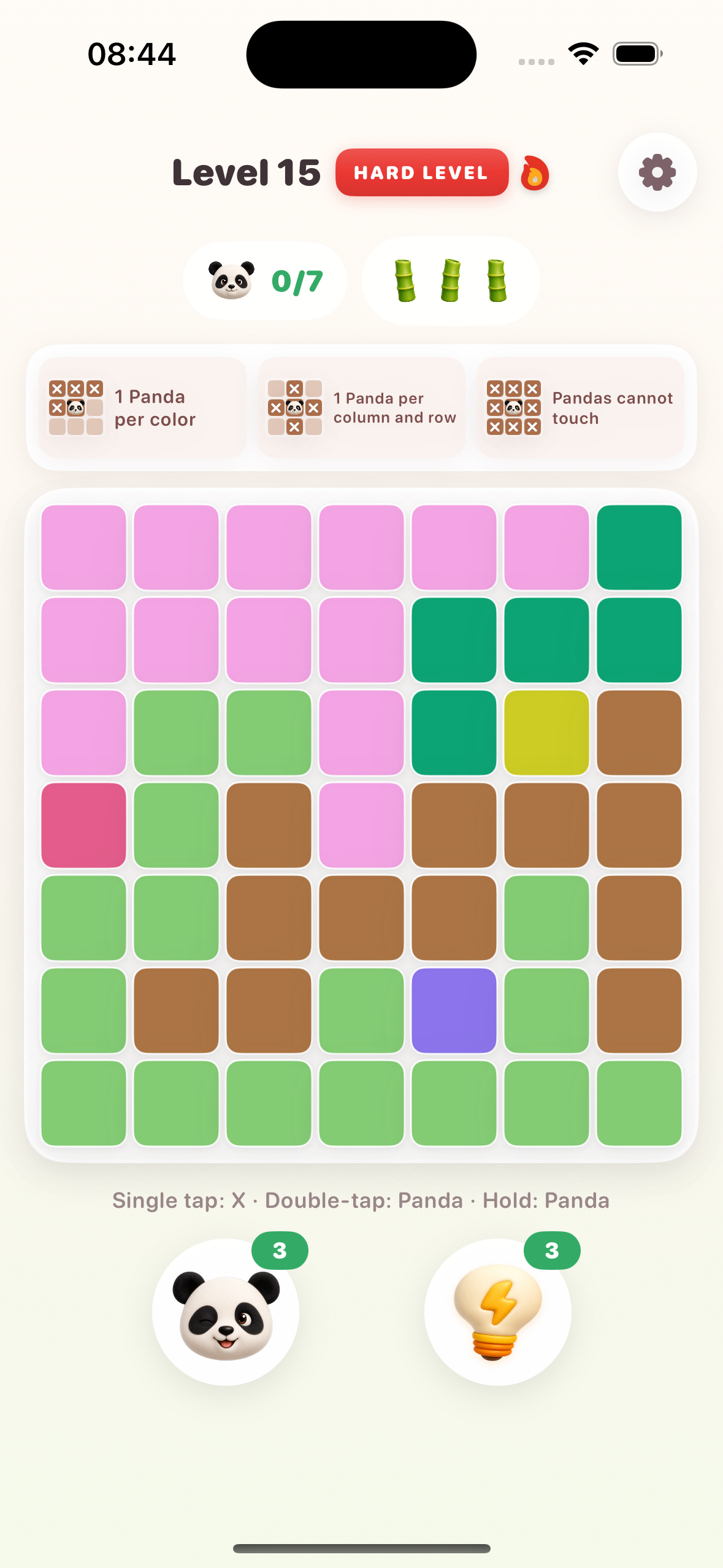
Which squares does a panda block?
Imagine a three-by-three box centered on the panda. Every other square in that box is blocked. Some are already impossible because they share its row or column, but the four corner squares are removed only by the no-touch rule.
At the edge of a board, part of that box falls outside the grid. This can make edge candidates attractive, but the correct choice still has to satisfy its color, row, and column constraints.

Why do diagonal exclusions matter so much?
A diagonal block often reaches into a different colored region. If that region has only two candidates and one touches the new panda, the other candidate is forced. The resulting panda may then force a third region, creating a deduction chain.
This is why a valid move can make the board feel as though it opens all at once. The animation is the reward, but the real satisfaction comes from seeing the chain you proved.
How can no-touching create forced moves?
Compare candidates that sit next to the same narrow region. If every possible panda position in one color would block one particular square in another color, that square can be excluded immediately. You do not need to know which first candidate is correct.
On a Hard or Super Hard board, pause after every placement and rescan the diagonal corners. Players often apply the long row and column exclusions but miss the short local deduction that actually advances the solve.
A practical solving loop
- 1
Visualize the three-by-three neighborhood around every placed panda.
- 2
Mark the four diagonal corners as well as the shared row and column.
- 3
Check whether those new X marks leave a nearby color with one candidate.
- 4
Repeat the adjacency scan after every new panda placement.