Both puzzles reward elimination and careful note-taking. Sudoku asks where each number belongs among repeated sets, while Pandaku asks which single square in each row, column, and irregular color region can hold a panda. The no-touch rule adds a spatial constraint that Sudoku does not have.
If you enjoy the feeling of narrowing candidates in Sudoku but want a faster, more visual mobile puzzle, Pandaku uses the same deductive mindset in a different form.
Does Pandaku use numbers or math?
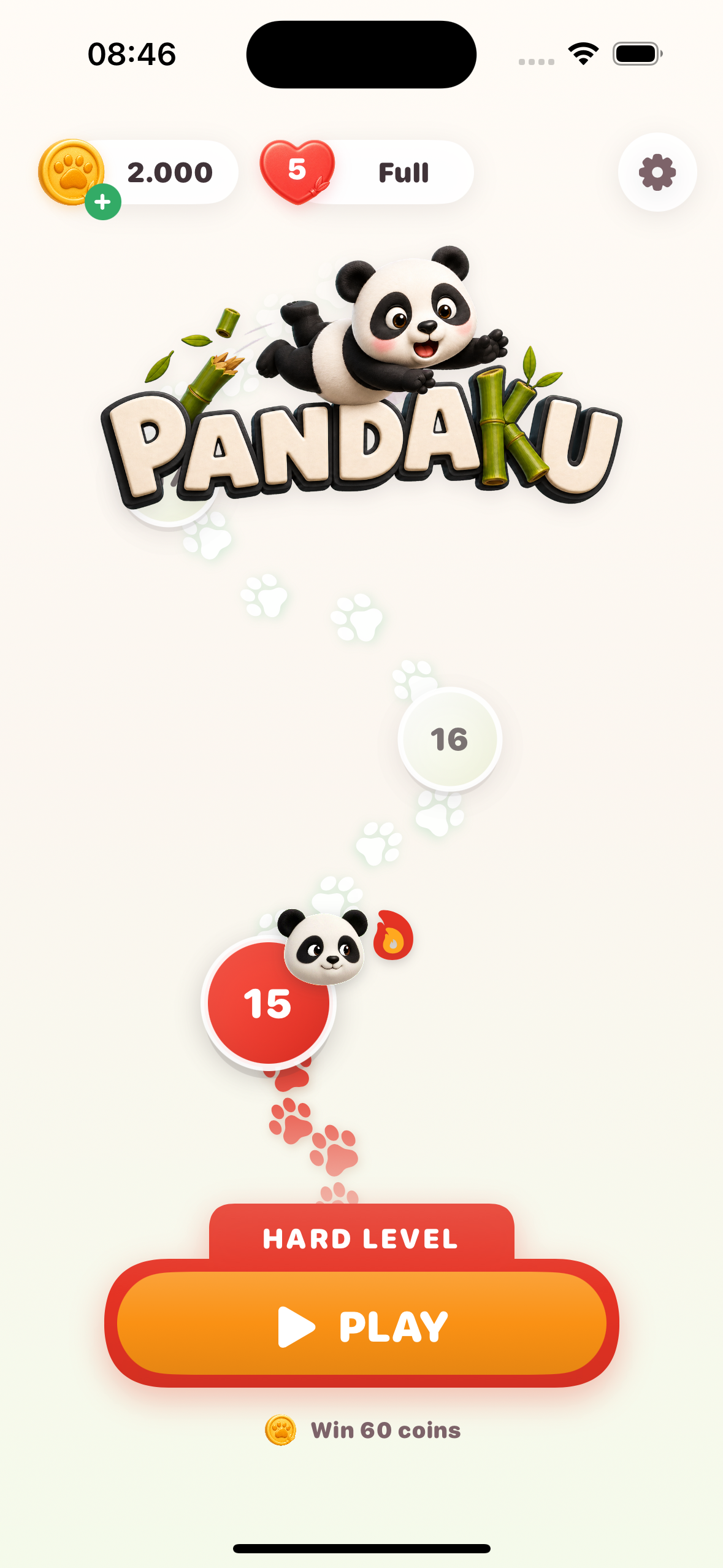
No. The colors and positions are the clues. You count candidates and compare lines, but there is no calculation and no need to remember numerical combinations. Every action is visible on the board.
The panda is also a single repeated object. A solved seven-by-seven board contains seven pandas, not seven copies of seven different symbols.
Which Sudoku skills transfer to Pandaku?
Candidate elimination transfers directly. So does the habit of scanning the most constrained line, recognizing pairs, and refusing to guess when the board should provide a proof. X marks play the role of pencil notes, but they record impossible squares rather than possible numbers.
Region awareness also transfers, although Pandaku’s regions are irregular shapes instead of fixed boxes. Their geometry becomes part of the puzzle.
What makes Pandaku feel different?
The tactile layer is central: placing a panda produces soft animation, particles, sound, and haptics. Endless generated puzzles move through Hard and Super Hard milestones without turning the screen into a dense spreadsheet.
Pandaku is designed around portrait touch controls. A single tap marks an X; a double-tap or hold places the panda. The interaction is closer to arranging a playful board than filling a form.
A practical solving loop
- 1
Replace number candidates with possible panda squares.
- 2
Scan colored regions the way you would scan Sudoku boxes.
- 3
Use rows, columns, and pairs to remove candidates.
- 4
Add the no-touch rule to check diagonal neighbors before every placement.