The most reliable strategy is to begin with constrained regions rather than scanning the whole grid randomly. A region that occupies only two rows, two columns, or a narrow edge gives information even before you know its exact panda square.
Each X mark should have a reason. When the candidates of one color are confined to a particular pair of rows, those rows cannot be used by certain candidates from other colors. This cross-pressure is how larger Pandaku boards remain solvable without guessing.
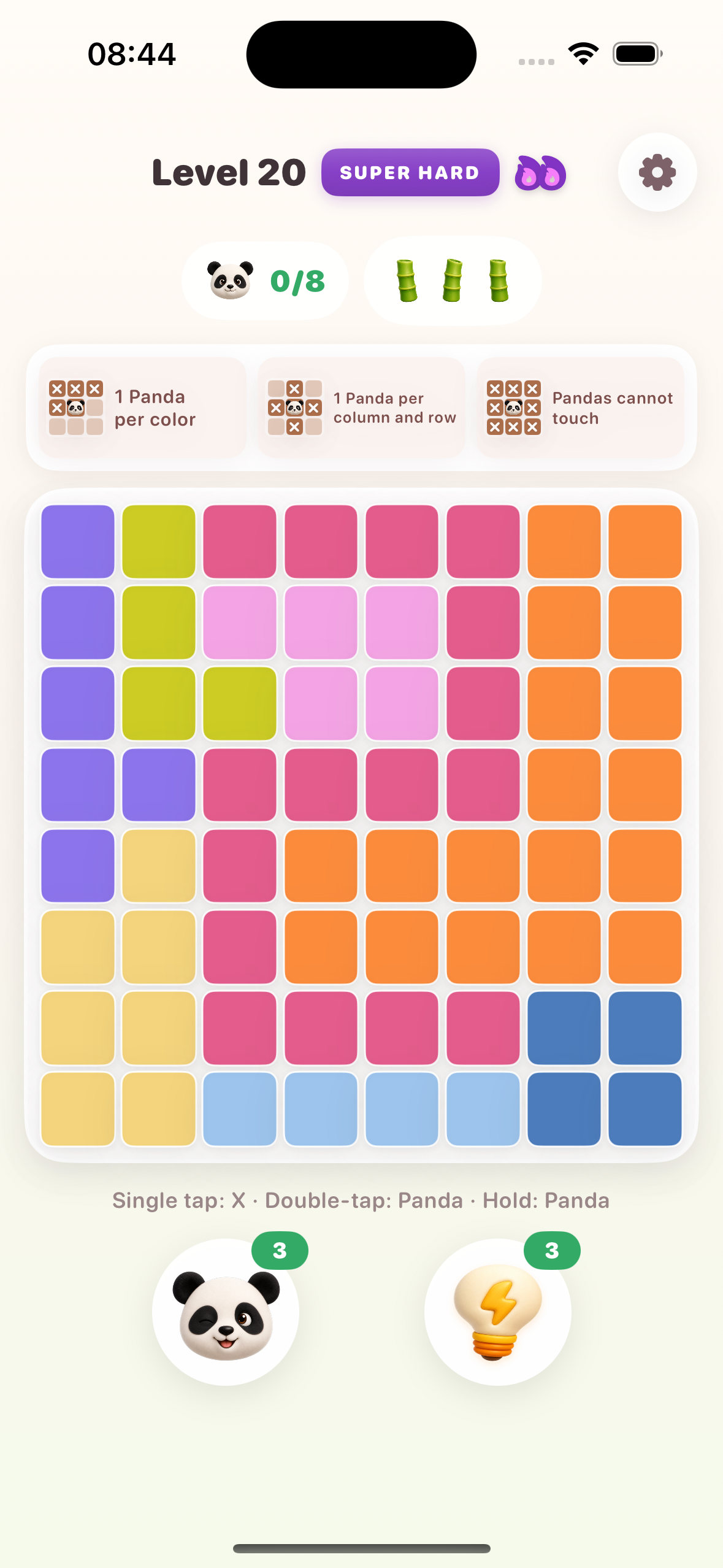
Which colored regions should you scan first?
Look for small regions, thin corridors, corners, and colors that occupy very few rows or columns. A four-square color stretched across four rows is usually less urgent than a larger color compressed into two rows, because compression creates a stronger line constraint.
Edges also matter. A candidate on the outer border has fewer neighboring squares, while a region wrapped around an existing panda may lose several cells at once. Count legal candidates, not just total cells.

How do rows and columns squeeze a region?
Once a row contains a panda, every other square in that row is impossible. The same is true for the column and color. Applying all three exclusions immediately is important: one placed panda can remove cells from several distant regions.
If every candidate for a color lies in two columns, that color must eventually occupy one of them. Compare this fact with another region that also depends on those columns. Candidate pairs can reveal a forced placement elsewhere even when neither color is individually solved.
What is a candidate pair?
A candidate pair occurs when a row, column, or color has exactly two legal squares. You cannot yet choose between them, but you can preserve the pair and inspect what both possibilities block. If either choice would eliminate the same third square, that third square is safely marked X.
On harder boards, several pairs chain together. Pandaku’s colored tiles and white X marks are designed to keep these relationships visible without a separate notes mode.
A practical solving loop
- 1
Count the legal cells in every color and identify the tightest region.
- 2
Apply completed row and column exclusions to every candidate in that region.
- 3
Record two-cell candidate pairs instead of guessing between them.
- 4
Follow shared exclusions until another row, column, or color has one cell left.